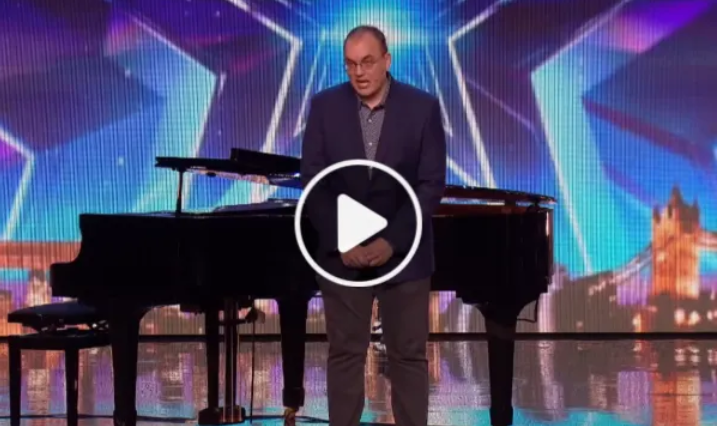
𝐖𝐚𝐭𝐜𝐡 𝐯𝐢𝐝𝐞𝐨 𝐢𝐧 𝐛𝐞𝐥𝐨𝐰 👇
At first glance, it didn’t look promising. The stage was quiet, almost too quiet, and Nicholas Bryant walked out carrying himself like someone who knew he wasn’t the obvious favorite. A piano, a bench, a brief nod to the judges. That was it. No theatrics. No buildup. Just a man and an instrument.
There’s a particular kind of tension in those early moments of talent shows, when the audience hasn’t decided how to feel yet. Watching Nicholas sit down, adjusting his posture, hands hovering over the keys, there was a sense that expectations were already settling somewhere low. Even the judges appeared distracted, their expressions suggesting they had seen this before.
The first notes didn’t challenge that assumption. They were steady, polite, almost cautious. A familiar Queen melody, played with care but not urgency. It’s possible that if things had continued that way, the performance would have quietly faded into the long list of “good, but not memorable” auditions.
Then something shifted.
A violin entered—not from the stage, but from somewhere in the audience. At first, it felt accidental, like a sound bleeding in from the wrong place. But then another instrument joined. And another. Slowly, almost playfully, the room began to transform. Musicians stood up from their seats, revealing themselves one by one, turning the audience itself into part of the performance.
It’s hard not to notice how quickly confusion turns into excitement in moments like this. Heads turned. People leaned forward. The judges, who moments earlier seemed disengaged, suddenly sat upright, scanning the room. There’s a kind of energy that builds when something unexpected happens, and here it felt almost electric.
Within minutes, the idea of “one man and his piano” had completely dissolved. A conductor appeared. A full orchestra emerged from scattered corners. Even voices joined in, rising from balconies and aisles, layering harmony over the growing sound. What began as something small had expanded into something immersive, almost overwhelming.
Nicholas himself seemed to shift with it. No longer just a pianist, he became part of a larger system, guiding and responding, occasionally stepping back as the music swelled around him. There’s a feeling that he understood exactly when to lead and when to disappear into the collective.
The choice of song mattered too. Queen’s “Don’t Stop Me Now” carries a certain momentum, a sense of movement that fits perfectly with this kind of reveal. As the performance built, it stopped feeling like an audition and started resembling something closer to a live concert. Not polished in the traditional sense, but alive.
There’s also something quietly compelling about the idea behind it. In an era where solo acts often dominate, this performance leaned in the opposite direction—toward collaboration, toward shared energy. It suggests that sometimes, the most powerful moments come not from standing alone, but from bringing others in.
Of course, not everyone watching would have been thinking about that. Some were simply enjoying the spectacle, the surprise, the sheer scale of it all. And maybe that’s enough. Still, there’s a sense that the performance carried a message, even if it wasn’t stated directly.
Watching this unfold, there’s a feeling that it tapped into something people don’t always expect from talent shows—joy without competition, music without tension. Just a room full of sound, growing larger with every second.
By the time the final notes landed, the transformation felt complete. The quiet stage from the beginning had disappeared entirely, replaced by something louder, fuller, harder to define. And Nicholas, who started as just one man at a piano, had become something else entirely.
