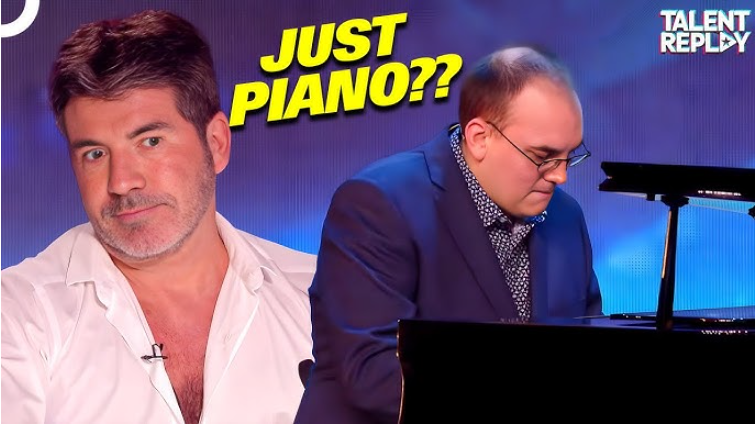
There is a particular and well-understood pressure that comes with a solo audition.
All of the attention, all of the panel’s focus, all of the room’s energy — concentrated on one person with nowhere to redirect it and no one else to share it with.
Most performers who step into that situation respond by making themselves as impressive as possible within the boundaries of what a single person can do alone.
Nicholas Bryant responded differently.
He used the solo audition format to set up something that was, by deliberate design, the precise opposite of solo.
The piano was the foundation.
But the structure he was building on that foundation required every musician he had placed in the room, every carefully timed entry point, every voice in the balcony, every patient participant who had arrived through the audience entrance carrying an instrument and a secret.
What that required from Nicholas was an artistic confidence that operates well beyond technical ability.
It required the willingness to make himself smaller so that the whole could become larger.
To step back at specific moments and allow the performance to belong to the room rather than to him personally.
Most performers find that instinct genuinely difficult to locate — particularly in a competitive format where individual visibility is a significant part of what is being evaluated.
He found it without apparent difficulty.
There were moments in the performance where Nicholas Bryant was not the focal point at all — where the cameras were following the reveal of a new musician in the crowd, or tracking the conductor’s entrance, or capturing the sound arriving from the balconies above.
And those were the most powerful moments.
Because they demonstrated that the performance was never really about what one person could accomplish alone.
It was about what a room full of people — working together, trusting each other, holding a collective secret — could become when given the right moment to let it go.
